Saturday, February 8, 2014

Neo Fauna Butterflies

There are 14,000 species of butterflies in Costa Rica.  Obviously, the Neo Fauna butterfly farm could not have them all.  However, they did have some very beautiful and interesting ones.  
As we entered the butterfly house, we could see butterflies flitting all around us.
Butterfly Enclosure
The enclosure was probably about 30' by 50' and filled with all kinds of plants.  Josymar, our guide, said the plants were specifically chosen for the butterflies and not for any kind of decoration.
There were some very strange looking caterpillars.
Caterpillar
One of the first butterflies Josymar pointed out was the Owl Butterfly.
There is an owl "eye" on each of the wings. When it flies, it looks like owl eyes.  Also, if you look closely at the end of the wing, it looks like a snake.  These markings deter predators.  
Predators of butterflies include birds, frogs, rats, lizards and iguanas, spiders, and even monkeys.  Most of these predators are afraid of owls and snakes.

I am not sure what kind of butterfly this is.  I just liked the vibrant orange color with the red flower.
Orange Butterfly


This is a Tiger Butterfly.
Tiger
This is a Zebra butterfly although somewhat different than the Zebra butterfly that is the state butterfly of Florida.
Zebra
But, the most beautiful butterfly of all is the Blue Morpho.
Blue Morpho Butterfly
The beautiful blue coloring of the Morpho butterfly is not due to pigmentation.  There are microscopic layers of scales on the wings that reflect light.  These scales are only on the top of the wing.  The bottom of the wing is brown so that when it stops flying it can hardly be seen.
Blue Morpho at rest
The caterpillars from which the Blue Morpho develop are interesting.  They are reddish brown in color with lime green and yellow spots.  They have little hairs that are irritating to human skin and, when touched, they emit an odor like rancid butter.  
After the butterfly hatches, it will only live for two to three weeks. Because of their unique glowing blue wings, these butterflies are reared in mass in certain parts of the world and their wings are used in jewelry and as inlays in woodworking.
They really are beautiful.
Beautiful Blue Morpho

Friday, February 7, 2014

NEO FAUNA FROGS

Some folks we met here at the condos told us about a place just outside of town called Neo Fauna.  This is a butterfly, reptile, and frog farm where they specialize in species that are becoming extinct.  They capture them, help them reproduce, and release them back into the wild.
So one morning we took off on our bicycles and headed north out of town.  Gail figured it was about six or seven miles to get there with the last quarter mile down a rocky dirt road.
When we got there it was not a very impressive place.
Neo Fauna Farm
However, based on the reports from the folks at our condo, we decided to take the tour--we are certainly glad we did.  Our guide was a young man, about 30 years old, by the name of Josymar.  He was extremely knowledgeable.  He has already written three books and spent time in Europe studying the use of DNA in cross-breeding. 
There were a number of interesting species of frogs. One was called the Strawberry Poison Dart or Blue Jean Poison Dart frog. 
Blue Jean Poison dart Frog
Here are some interesting facts about this frog:

Though small, males of this species are aggressively territorial. During the day, males perch on rocks, trees, or fallen logs, and make calls. These are both to attract females to mate as well as to intimidate trespassing males. If an intruder persists and calls back, a wrestling competition may result for up to 20 minutes. The males stand upright on their hind legs and grapple for dominance. Once one is pinned for several minutes he will leave after the winner releases him.

The fascinating reproductive process of this species has captured the interest of biologists and tourists alike. When a female meets a male, he leads her to a place to lay their eggs, such as in a curved leaf or in moist leaf litter. Unlike many frogs, the male does not climb onto the female’s back in amplexus, but instead the pair stands vent to vent, or with their tails together. The female lays 3 to 4 eggs, the male fertilizes them, and his mate leaves. The parental care beginning at this stage is unmatched by other amphibians. The male keeps the eggs moist by emptying his bladder on them. He also eats any eggs that are infected with fungi or that do not develop, as well as any eggs left by other males. Tadpoles hatch after one week, when the female returns. One to four tadpoles at a time squirm onto her back, and she carries each one to a different plant or leaf stem that is holding water—bromeliads are often the choice. These carefully chosen nests are sometimes in the canopy, high up from the frog’s otherwise ground-level habitat. Amazingly, the tadpole chooses its spot by vibrating when the mother approaches a desirable spot. Each tadpole is placed in a separate plant, where the mother leaves it with 1 to 5 unfertilized eggs for protein and nutrients. For more than a month, the female returns every few days to feed her young.

The frog’s bright colors warn off predators because the colors signal the toxicity for which the Poison-dart is named. The Strawberry Poison-dart Frog is not known to be lethal to man, but its skin secretions may have unpredictable effects on humans. Other species in this frog’s family have been used to make blowgun darts especially lethal. The most lethal animal toxin known belongs to a frog (Phyllobates terribilis) related to the Blue-jeans; poison from a single individual can kill twenty thousand mice or ten adult humans. Needless to say, brightly colored relatives like the Blue-jeans have few predators, and once it reaches adulthood, this frog can live for 5 or 6 years. As eggs, however, this species is preyed upon by fungi, worms, snakes, and even other Blue-jeans.

Josymar told us that the poison from the frog must enter the blood stream in order to be effective.  He took the frog in his cupped hands and shook it like dice--no problem.  He said he once wanted to see what it felt like to be poisoned by the frog.  He intentionally cut his hand and rubbed the frog on the cut.  Within minutes his heart began racing (he said it ultimately got up to around 200 beats per minute). He had trouble breathing, he could not swallow, and he could not see.  After about thirty minutes he started to return to normal.  He was pretty certain he would survive because he was young and healthy. If, however, he would have had some vulnerability in his body like asthma, for example, he probably would not have survived. There is no antidote because the poison keeps changing depending on the diet of the frog.      


We also saw this little guy.


Fighter Frog
Not very pretty but the interesting thing about him is that he will fight another male for a female.  The way they fight is that they jump at each other and butt heads (like you see mountain goats do) until one of the males retreats.

One of the most impressive frogs we saw was this one.


Sleeping Red Eyed Leaf Frog
What is so impressive about this guy, you ask?  Well, in this picture he is sleeping.  When he wakes up, he looks like this:


Red Eyed Leaf Frog

He is called the Red-Eyed Leaf Frog.  There are 174 species of frogs in Costa Rica but this was by far the most colorful one we saw.  

Instead of hopping or walking like frogs that spend a lot of time on the ground, this frog climbs hand over hand through the trees. The adhesive disks on its toes and fingers help the frog cling to surfaces that are entirely vertical; this species also has a toe joint that keeps the toe disk flat on a surface no matter how the frog positions its feet. This frog can even parachute, by spreading out its gangly limbs and large feet and dropping from higher perches to lower branches.


The Red-Eyed Leaf  Frog is one of the most widely photographed and recognized amphibians in Central America. 

Tuesday, February 4, 2014

Macaws

The entire time Chuck and Sharon Cobbs were visiting, we walked miles looking for Macaws.  They would fly over our condo almost every morning. You could hear them coming because they make a very loud and unique noise.  It is difficult to catch a picture of them however because they are a large bird and move quickly.  Gail was able to get this picture.
Macaws Flying
But....on the last day Chuck and Sharon were here, the morning they were packing to leave, the Macaws came.
Chuck and I were inside when the girls came running in whispering loudly, "Get your cameras, get your cameras".
We went outside and there in the tree right outside our condo door were six pairs, twelve birds.  These birds mate for life and this morning three of the pairs were definitely mating.   
Tree Full of Macaws
The colors of these birds is amazing.
Beautiful Colors
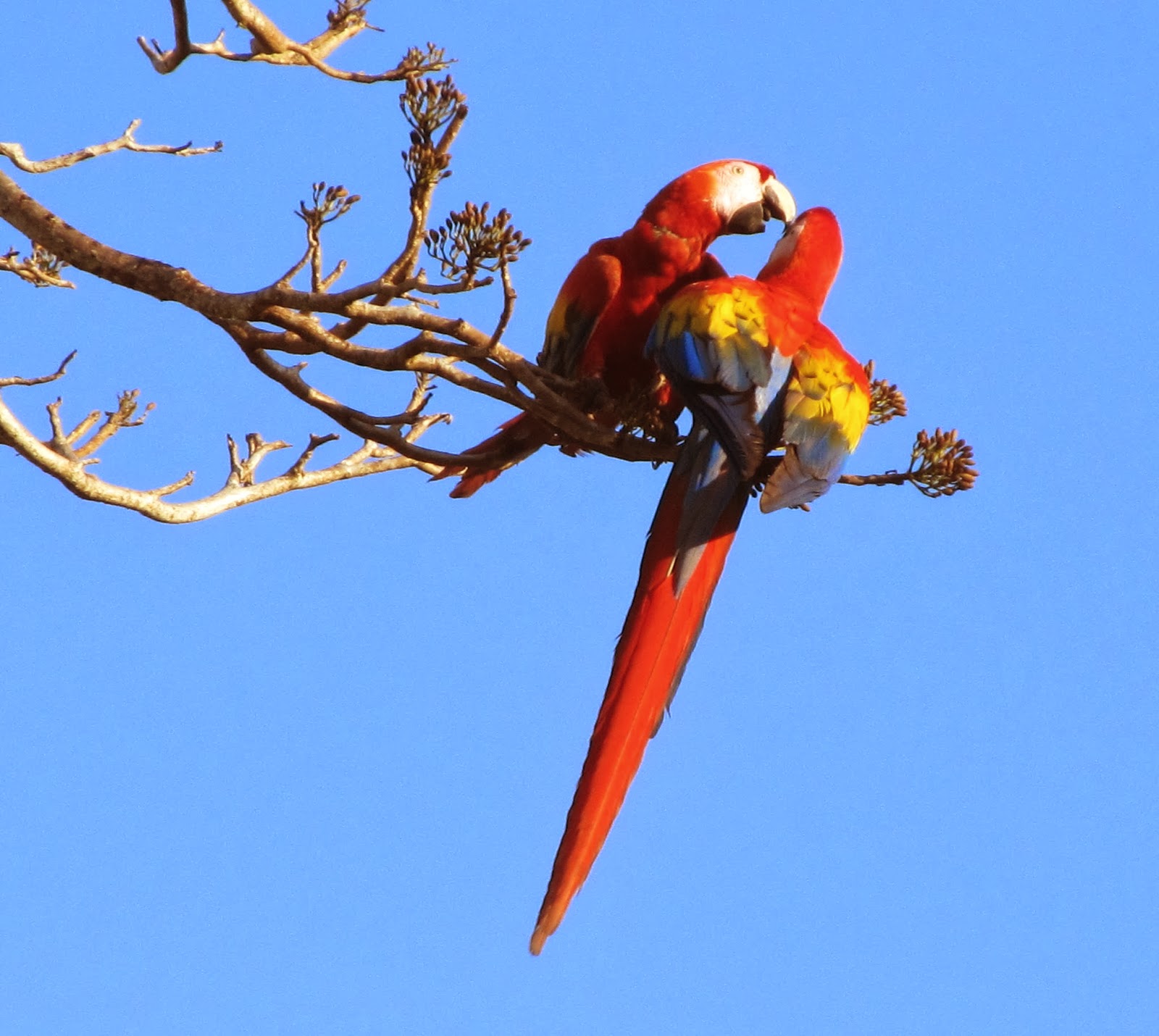
The pairs that were mating would almost look like they were kissing.
Kissing Macaws
They would squawk at each other.
Mating Macaws
Then one would hang upside down--not sure which one.
Macaw Mating Ritual
And then squawk some more.  It was quite a sight for almost a half hour.  Beautiful birds!
The colors of the macaw
What a great send off for Chuck and Sharon!


Miro Mountain

At the South end of our beach is Miro mountain.  It's not a big mountain.  A lot of the more energetic people climb it almost every day.  They say there are Macaws, Toucans, monkeys, parrots, and even jaguars up there.  There are also some relics of a hotel someone started to build at one time.
Miro Mountain Relics
While Chuck and Sharon Cobbs were here visiting, we decided to climb Miro Mountain.  From the very beginning we could tell it was going to be some good exercise.
As we walked up the road there was a concrete wall on one side of the path that had been etched with various animals found in the area.
Wall of Etchings

These included everything from Toucans to Jaguars.
Toucan

Jaguar


And some we were not even sure what they were.


This wall went on for quite a ways.  It supposedly was made by the guy who began building the hotel.  
When we finally made it up to the structure of the hotel ruins, it was pretty amazing.


As we continued up the mountain the views of Jaco and the beach in front of our condo complex were fantastic.
At the very top of the mountain is a station for the local zip lining company.  We made it all the way to the top but it was pretty exhausting.  After a rest, we started our descent.
Descending
At the bottom of these steps, Sharon let out a whispered yell.  We all gathered around to see what she had found.  YOU WILL NEVER BELIEVE--it was one of the rare black and green poisonous dart frogs.
Rare Black and Green Poisonous Dart Frog

Sharon had redeemed herself.

I wish I had a way to contact Armando, our Guide at Carara, and tell him where he could come and find this rare creature.

We will definitely go back up the mountain to see what other creatures we can find.

Sunday, February 2, 2014

Surfing Contest #2

Yesterday we went back to Hermosa Beach and the Backyard Bar and Restaurant for the weekly surfing contest.  We went with Gus and Carol MacDonald, a couple we met from Canada--of all places.  The reason we went back is because the high tide was at 4:00 pm, exactly when the contest starts, and the waves were to be the highest of any that are going to be happening in the time we have left here--10 feet.  I wanted to see if I could get some better pictures of the surfers.
We arrived a little early so we could get a front row seat.


The waves were big and the surfers were flying, as predicted.


The sun sets at a little after 5:30 and the surfing continues until a little after 6:00.
The sunset was one of those that has the small clouds in the sky that the sun seems to just light up.

And then the afterglow changes colors.

It was a good night and home early--Super Bowl tomorrow.

Saturday, February 1, 2014

Carara

Carara is a national park about ten miles north of Jaco.  The red dot on the map shows the location. 
Carara National Park
It is a rain forest environment and therefore has a lot of plants, animals, birds, AND bugs.  We drove there with Chuck and Sharon Cobbs and hired a guide (Armando) to show us the park and its inhabitants.
The forest/jungle was pretty dense and hot so we wore cool clothes and covered ourselves with inspect spray.
Trekking through Carara
One of the first things that impressed me was how big the trees were.


Many of the trees do not have deep root systems so they put out a large base of roots for stability.

One of the most lovely trees you see all over the mountain side is called either "Brazilian Fire" because of it's color or "Chicken Feet" because of it's roots.  I like "Brazilian Fire".
Brazilian Fire

One of the first things Armando wanted to show us as we began walking through the forest was a very rare black and green poisonous dart frog.  The natives used to rub their darts on this frog to get the poison to kill their prey.  He knew where this frog lived and had shown it to many visitors in the past.  We would be so lucky to be able to catch a glimpse of this rare species.   He began gently brushing back the undergrowth trying to find this rare black and green poisonous dart frog. Chuck and I were getting our cameras ready.  Finally, "There it is" he said.  As we all pressed forward, Sharon bent over to get a closer look.  As she did, her sun glasses slipped off her head and plummeted to the ground coming very close to skewering the rare black and green poisonous dart frog.  He was gone!  We looked and looked.  Armando was frantically trying to find the rare black and green poisonous dart frog once more.  No luck.  
Later in our tour we returned to this same spot to see if he had returned.  But no, he was no where to be found.  Armando explained that he would probably never return because he now sensed danger having been almost skewered by the jeweled sunglasses of the blond Gringo lady.
Since we did not see the rare black and green poisonous dart frog, Gail asked Armando if he had a picture of it.  So what you have here is a picture of the rare black and green poisonous dart frog that I took from a page in Armando's Guide Book.  
(More of this story to follow in a later blog.)
Very rare black and green poisonous dart frog.
 We continued on and eventually Armando began talking to us again.
Armando had a telescope and we could take pictures through it of the animals occupying the tree tops.

We saw a lot of tree top dwellers--Birds


and bats.
Albino Bat

 Creepy Little Devils but they can eat up to 500 mosquitoes in one night.
The best part of the tour was walking through this wonderful area and seeing the various types of plants.


We saw many other animals like Iguanas and leaf cutting ants. There are way too many pictures to put on the blog. 

We made it home in time to see the sunset.